Accessibility of public-access buildings (ERP): the importance of a qualified assessment

Any effective accessibility initiative starts with an objective, documented assessment of the existing situation. Before considering works, budget trade-offs or administrative procedures, it is essential to have a clear view of the establishment’s actual level of compliance.

In France, any building, premises or enclosed space open to the public, whether a shop, a museum, a town hall, a restaurant or an event venue, is classified as an Établissement Recevant du Public (ERP), a public-access building.

These establishments are required to comply with the accessibility regulations in force. Their managers must guarantee every visitor optimal conditions of safety, comfort and autonomy, whatever their needs.

Carrying out an accessibility assessment is the essential first step for any establishment seeking to master compliance and usability issues.

Beyond regulatory compliance, an accessibility review identifies gaps in comfort of use and opportunities for optimisation, and helps prioritise the actions needed to control the legal and operational risks of the accessibility system.

New or existing buildings: different requirements

For a new building, the rule is simple: accessibility must be built in from the design stage, with no possible exemption, which means full compliance with current standards. An existing building, by contrast, has to work with a built reality that may be old, with technical, heritage or financial constraints, and may in certain strictly regulated cases apply for exemptions. This does not mean lower standards, but a more progressive approach based on continuous improvement and solutions suited to each context.

The importance of a qualified assessment

An accessibility review is not just a matter of reading the standards. It requires a cross-cutting approach combining:

  • The requirements of the French building regulations (Code de la construction et de l’habitation)
  • The real conditions of use for all visitors
  • The technical and economic constraints specific to each establishment

Based on an accessibility review of routes, signage, facilities, organisation and practices, managers gain a usable decision-making tool and actionable insights to build lasting, consistent and effective accessibility for all users.

Article author: Pedro Indacochea
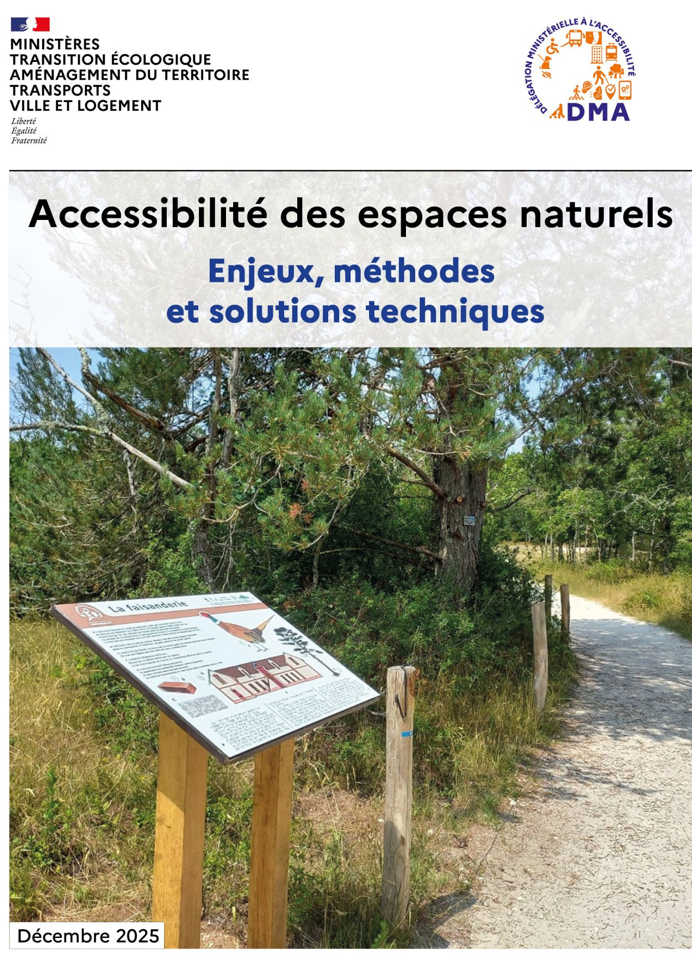
Cover of the technical guide on the accessibility of natural spaces

Cover of the technical guide on the accessibility of natural spaces (in French)

The publication in December 2025 of the technical guide Accessibility of Natural Spaces: Challenges, Methods and Technical Solutions marks a structuring step forward for local authorities, managers of natural spaces and planning professionals.

This national reference document meets a long-identified need: a shared, reliable and operational methodological framework to improve the accessibility of natural spaces open to the public, in a context where no specific regulations apply.

By providing common reference points, the guide helps harmonise practices, secure the decisions of project owners and strengthen the consistency of public policies on inclusion, the environment and visitor services.

VivAccess’s contribution

As part of this partnership-based initiative, VivAccess is proud to have contributed to the drafting of this guide. This contribution reflects its ongoing commitment to universal accessibility and to supporting public bodies in designing and implementing inclusive, sustainable projects suited to their environmental and territorial contexts.

Why is the accessibility of natural spaces a major challenge?

Access to nature is a recognised driver of public health, well-being, social ties and territorial attractiveness. As such, it is fully part of today’s challenges of ecological transition, social justice and quality of life.

Yet many natural spaces remain difficult to access for people with disabilities, older people, families with young children or people with temporarily reduced mobility. These access limitations create de facto exclusion, often unintentional, and deepen territorial inequalities.

Improving the accessibility of natural spaces therefore means acting simultaneously on:

  • Equal access to natural spaces
  • The diversification and safety of uses
  • The overall quality of the welcome for all visitors

A methodological framework for local authorities

In the absence of regulations applicable to natural spaces, the guide proposes a structured voluntary approach based on the principles of universal accessibility. It enables local authorities and site managers to:

  • Rely on clear reference points to guide their choices
  • Build accessibility into projects from the earliest stages
  • Make this approach a cross-cutting pillar of planning and management policies, rather than a one-off or corrective response

Key takeaways

  • The guide takes a realistic approach suited to the diversity of territorial contexts and natural environments, to support decision-making by local authorities acting as project owners and project managers
  • Accessibility is addressed across the whole travel chain, from pre-visit information to on-site paths, facilities and services
  • The guide stands out for its operational dimension. The appended technical factsheets are a practical tool for designing, building and managing facilities
  • The guide contributes to a paradigm shift. It guarantees people with disabilities effective equal access to these spaces

Useful links

Article author: Florian Castel